
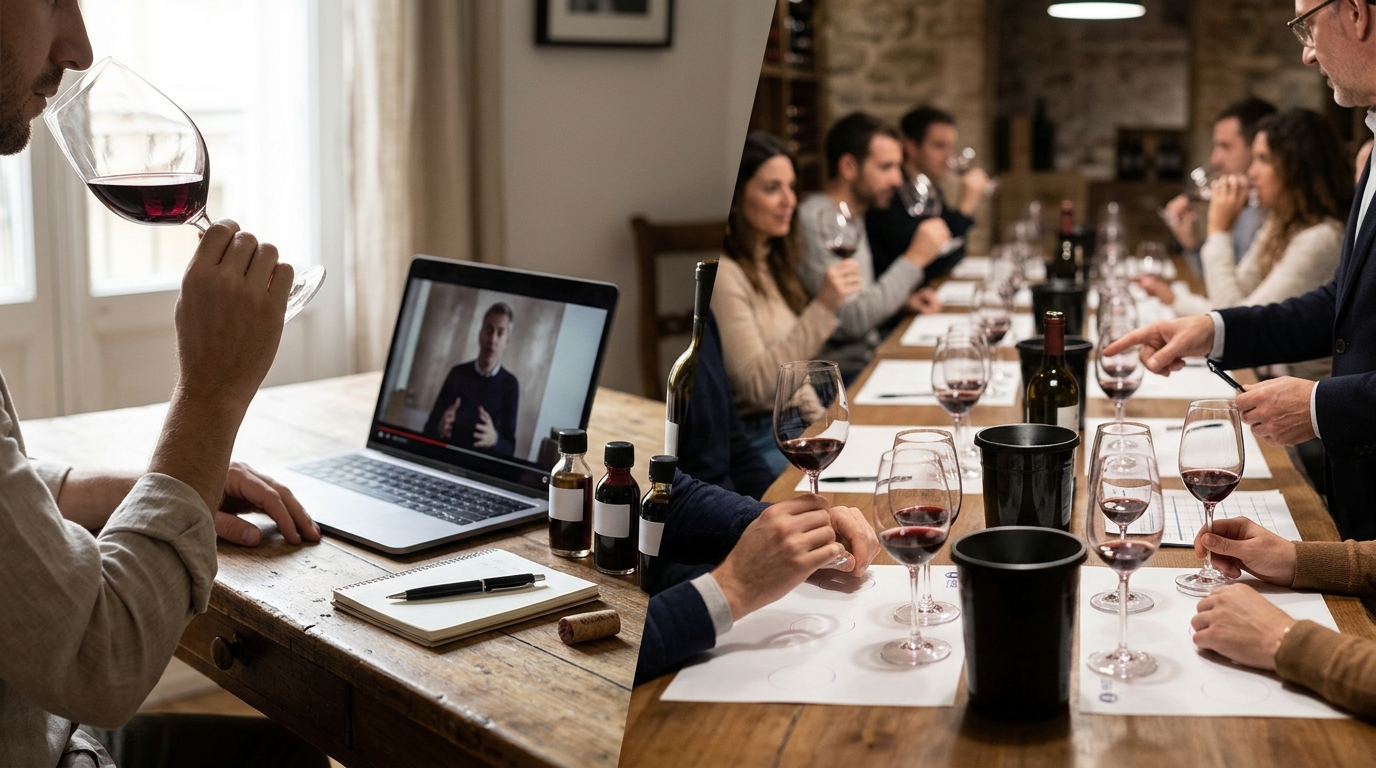
7 Key Differences in Tasting Practice Between Online and In-Person WSET Training
Wine tasting is a multisensory skill that requires consistent calibration of sight, smell, and taste. The method you choose to practice this skill significantly impacts how quickly you develop professional accuracy. Rack and Return, a WSET-certified provider in Barcelona, offers both formats to help students find the right balance for their learning style. This guide breaks down the specific operational differences between studying at home and attending a physical classroom.
1. Sensory Calibration and Environmental Control
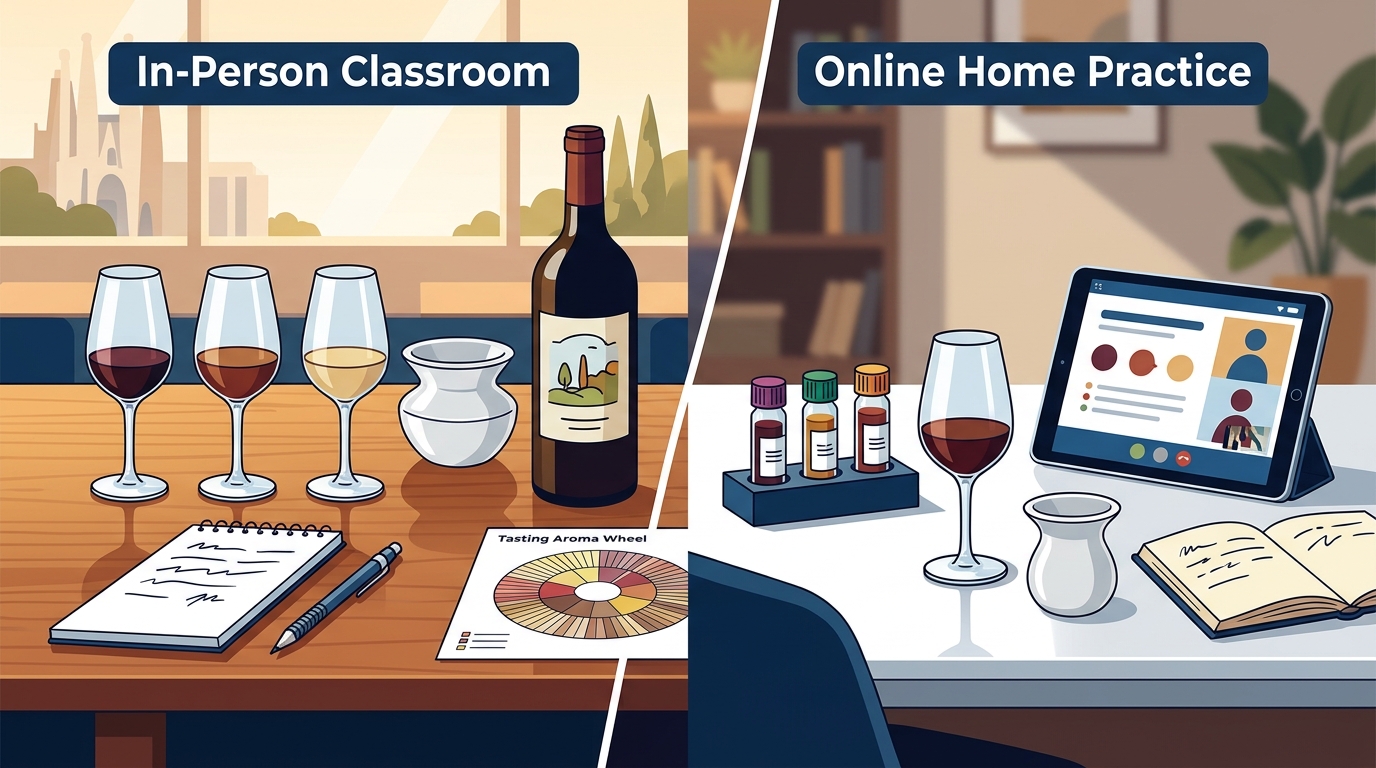
In-person classes provide a neutral, standardized environment that eliminates home distractions. In a physical classroom, the lighting, temperature, and background noise are controlled by the instructor. This consistency helps students focus purely on the wine's aromas and flavors without interference from household smells or ambient noise. Online students must create their own neutral tasting space, which can be challenging in a home setting.
2. Real-Time Instructor Feedback on Technique
Physical instructors can observe and correct your physical tasting posture and technique in real time. The WSET Systematic Approach to Tasting (SAT) requires specific physical actions, such as the angle of the glass and the depth of the sniff. In a classroom, a teacher can see if you are holding the glass incorrectly or if your facial expressions indicate a specific sensory reaction. Online, this visual feedback loop is absent, requiring students to rely on self-discipline and video resources.
3. Wine Sourcing and Logistics
Online courses shift the responsibility of wine procurement entirely to the student. In-person classes typically include all tasting samples in the course fee, ensuring you taste the exact wines discussed in the lecture. For online learners, Rack and Return provides a recommended wine list and optional tasting packs. You must source, purchase, and store these wines yourself, which adds a logistical layer to the study process.
4. Pacing and Repetition of Tasting Sessions
Online platforms allow for unlimited repetition of specific tasting modules at your own pace. In a live class, the tasting session moves forward with the group, and you cannot pause to re-smell a wine if you missed a nuance. Online, you can pause the video, re-taste the wine, and take detailed notes without time pressure. This flexibility is ideal for students who need more time to process complex flavor profiles.
5. Peer Interaction and Comparative Tasting
Classroom settings facilitate immediate peer comparison, which sharpens sensory perception. When tasting in a group, you can compare your notes with classmates and discuss discrepancies in real time. This social calibration helps you understand that sensory perception is subjective. Online, interaction is often asynchronous, meaning you may not get immediate feedback on how your tasting notes compare to others in your cohort.
6. Access to Diverse Wine Selections
In-person schools in major wine hubs often have access to a broader range of local and international wines. Rack and Return, located in Barcelona, sources wines directly from wineries, including local Spanish varieties that might be harder to find online. Online students in regions with limited wine retail access may struggle to find the specific vintages or styles required for the curriculum.
7. Exam Simulation and Pressure Testing
Choosing the Right Format for Your Goals
Select your format based on your primary learning bottleneck. If you struggle with sensory calibration and need immediate feedback on your technique, choose in-person training. If you need flexibility to repeat modules and have reliable access to wine, online study is a viable alternative. Many students at Rack and Return combine both approaches, using online resources for theory and in-person sessions for practical tasting refinement.
Frequently Asked Questions
Can I pass WSET Level 3 using only online tasting practice?
Yes, it is possible to pass WSET Level 3 with online study, but it requires exceptional self-discipline. The Level 3 tasting exam is rigorous, and many students find that in-person practice helps them calibrate their sensory skills more effectively. Rack and Return offers online courses for Levels 1 and 2, while Level 3 is typically delivered in-person to ensure adequate practical preparation.
Do online WSET courses include the same wines as in-person classes?
Online courses provide a recommended wine list that mirrors the in-person curriculum. You can purchase these wines yourself or buy a pre-assembled tasting pack from the provider. The specific vintages may vary slightly depending on availability, but the styles and regions covered remain consistent with the WSET syllabus.
How important is peer interaction in wine tasting education?
Peer interaction is valuable for calibrating subjective sensory perceptions. Discussing notes with classmates helps you understand the range of acceptable descriptions for a wine. While not strictly required for passing, this social feedback loop is a significant advantage of in-person learning.
Is the WSET Systematic Approach to Tasting (SAT) taught differently online?
The core principles of the SAT are identical in both formats. However, the delivery method differs. In-person instructors can demonstrate the physical movements of the SAT and correct your form. Online, you learn the SAT through video demonstrations and written guidelines, requiring you to practice the physical actions independently.
Which format is better for hospitality professionals?
Hospitality professionals often benefit from in-person training due to the emphasis on service skills and peer interaction. However, if your schedule is unpredictable, online courses offer the flexibility to study around work commitments. Many professionals use online courses for theory and attend in-person workshops for practical tasting sessions.