

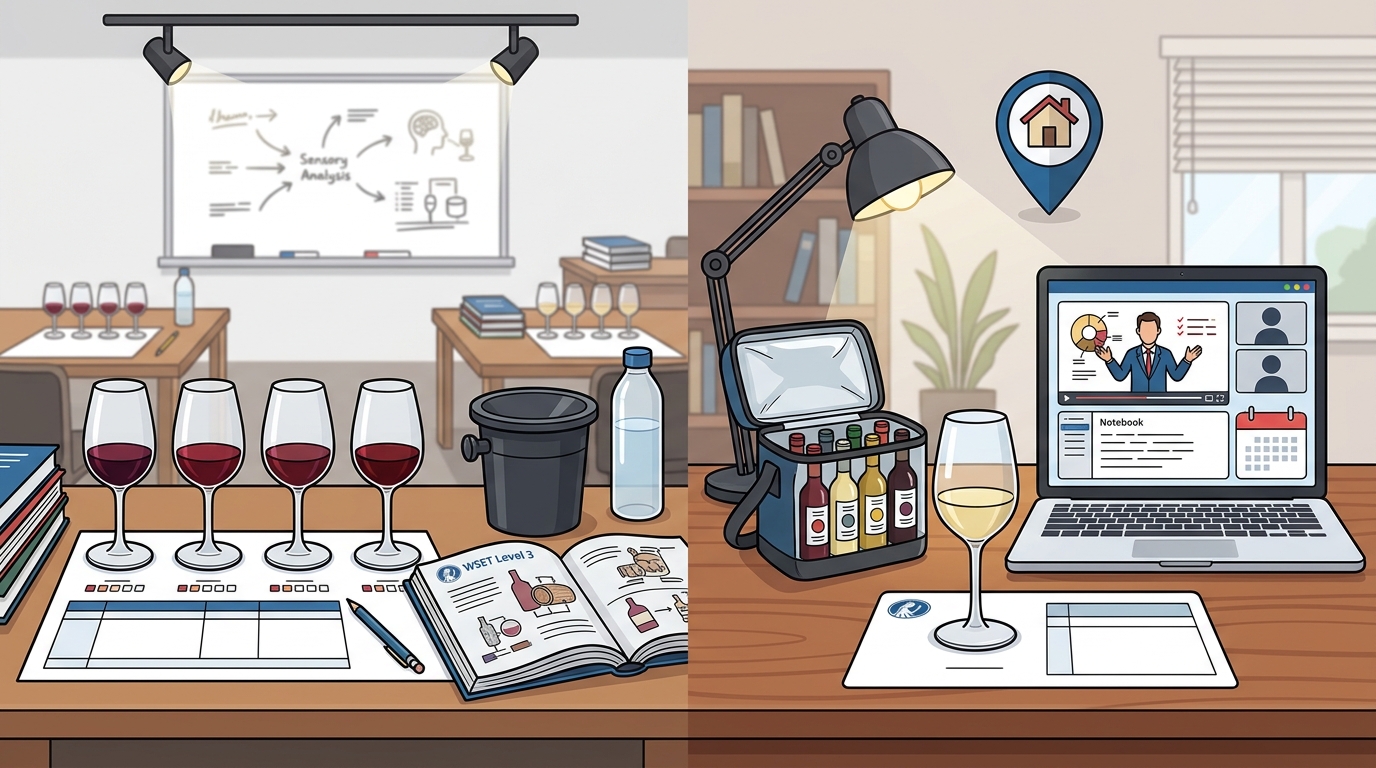
The real difference in how you practice wine tasting between online and classroom WSET training lies in the immediacy of sensory feedback and the physical environment. Classroom training provides a controlled, shared tasting space where you can compare wines side-by-side with peers and receive instant instructor corrections. Online training offers flexibility and self-paced repetition, allowing you to practice in your own environment, but it lacks the immediate social calibration and standardized conditions of a physical classroom. At Rack and Return, we design both formats to ensure you develop a reliable, repeatable tasting method regardless of where you study.
The Sensory Environment: Controlled vs. Personal
Classroom tasting occurs in a standardized environment where lighting, temperature, and glassware are consistent for every student. This uniformity is critical because wine tasting is a relative exercise. When you taste a Chardonnay next to a Sauvignon Blanc in a classroom, the contrast is immediate and unambiguous. The physical presence of other tasters also creates a social calibration effect. You can observe how others react to a specific aroma or flavor, which helps you verify your own sensory perceptions. This shared experience reduces the likelihood of individual bias or sensory fatigue going unnoticed.
Online tasting, by contrast, takes place in your home or office. While this allows for a relaxed atmosphere, it introduces variables that can skew your results. Your kitchen lighting, the specific glass you use, or even the ambient noise can influence how you perceive a wine. However, the online format allows for a level of repetition that is difficult to achieve in a classroom. You can pause a video, re-taste a sample, and take detailed notes at your own pace. This iterative process is essential for building a personal sensory library. At Rack and Return, our online courses include specific guidance on setting up your home tasting station to minimize these environmental variables.
The Feedback Loop: Immediate vs. Asynchronous
In a classroom setting, the feedback loop is immediate. If you describe a wine as having a strong oak character, your instructor can instantly ask you to re-taste and distinguish between vanilla, toast, or coconut. This real-time correction prevents bad habits from forming. The instructor can also adjust the difficulty of the next sample based on your performance. This dynamic interaction is a significant advantage for students who struggle with specific sensory categories. The social pressure of a classroom also encourages you to articulate your thoughts clearly, which is a key component of the WSET Systematic Approach to Tasting Wine (SAT). according to How MW students
Online feedback is asynchronous. You submit your tasting notes, and your instructor reviews them later. While this allows for more detailed, written feedback, it lacks the immediacy of a live correction. You might spend an hour analyzing a wine before receiving feedback, which can lead to overthinking. However, the written nature of online feedback allows you to revisit the comments repeatedly. You can compare your initial notes with the instructor's corrections and see exactly where your perception diverged. This method is particularly effective for students who are self-motivated and enjoy detailed analysis. Our online instructors at Rack and Return provide comprehensive written feedback on every assignment to ensure you understand the reasoning behind each correction.
Social Calibration and Peer Learning
Wine tasting is not just a solitary act; it is a social skill. In a classroom, you are surrounded by other students who are also learning to taste. This peer group provides a valuable reference point. When you taste a wine, you can compare your notes with a classmate's. If you both identify the same primary aromas, your confidence increases. If you identify different aromas, you can discuss the differences and learn from each other. This peer learning is a powerful tool for developing a nuanced palate. It also helps you understand that wine tasting is subjective, and there is often more than one valid interpretation of a wine's profile. according to How do you
Online learning lacks this immediate peer interaction. You are tasting alone, which can make the process feel isolating. However, online platforms often include discussion forums or group chat features where you can share your notes with other students. While this is not as immediate as a classroom discussion, it still provides a valuable opportunity for peer feedback. You can see how other students from different backgrounds and regions perceive the same wine. This global perspective is a unique advantage of online learning. It exposes you to a wider range of sensory experiences and cultural contexts. At Rack and Return, we encourage our online students to engage with the community to enhance their learning experience.
Repetition and Depth of Practice
Classroom time is limited. You might spend 30 minutes on a specific tasting exercise, and then move on to the next topic. This structure ensures you cover a broad range of wines and styles, but it limits the depth of practice for each individual sample. You do not have the time to spend an hour analyzing a single wine. This breadth is essential for passing the WSET exam, which covers a wide range of wine styles and regions. However, it can feel rushed if you are struggling with a particular concept.
Online learning allows for unlimited repetition. You can spend as much time as you need on a specific wine or concept. This depth of practice is crucial for mastering complex sensory skills. For example, if you are struggling to identify the difference between primary, secondary, and tertiary aromas, you can practice with multiple examples until you feel confident. This self-paced approach allows you to focus on your weak areas and build a strong foundation. It also allows you to integrate tasting into your daily life. You can taste a wine with dinner and then review your notes later. This integration of learning and daily life is a significant advantage of online training. Our online courses at Rack and Return are designed to support this flexible, self-paced approach to learning.
Choosing the Right Format for Your Goals
The choice between online and classroom WSET training depends on your learning style and goals. If you thrive in a social environment and prefer immediate feedback, a classroom course is likely the better choice. The shared experience and real-time interaction will help you develop your tasting skills more quickly. If you are a self-motivated learner who prefers flexibility and depth, an online course may be more suitable. The ability to repeat exercises and work at your own pace will allow you to build a strong, personalized sensory library. Many students choose a hybrid approach, taking an online course for the theory and then attending a classroom workshop for practical tasting practice. This combination offers the best of both worlds. At Rack and Return, we offer both formats to accommodate different learning preferences and schedules.
Key Takeaways
- Classroom tasting provides a standardized environment and immediate social calibration, which helps reduce individual bias.
- Online tasting offers flexibility and unlimited repetition, allowing for deeper, self-paced practice in a personal environment.
- Immediate feedback in a classroom prevents bad habits from forming, while asynchronous online feedback allows for detailed review.
- Peer learning in a classroom provides a valuable reference point for subjective sensory perceptions.
- Online learning exposes you to a global perspective through discussion forums and diverse student groups.
- Classroom time is limited in depth but broad in scope, while online learning allows for unlimited depth but requires self-discipline.
- A hybrid approach, combining online theory with classroom practice, is often the most effective strategy for WSET success.
Frequently Asked Questions
Is online WSET tasting as effective as classroom tasting?
Yes, online WSET tasting is highly effective, especially for self-motivated learners. It allows for unlimited repetition and detailed self-analysis. However, it lacks the immediate social calibration and standardized environment of a classroom. Many students find that a combination of both formats yields the best results.
How do I set up a proper tasting environment at home?
Choose a quiet, well-lit room with neutral lighting. Use clean, stemless or stemmed glasses that are free of odors. Ensure the room is at a comfortable temperature, ideally between 18-20°C. Avoid strong scents like perfume or cooking aromas that can interfere with your sense of smell.
Can I pass the WSET exam with only online training?
Yes, many students pass the WSET exam with only online training. The exam is a multiple-choice test that assesses your knowledge and understanding of wine. Online training provides the necessary theory and tasting practice. However, some students prefer to attend a classroom workshop for additional practical experience before the exam.
What is the WSET Systematic Approach to Tasting Wine (SAT)?
The WSET Systematic Approach to Tasting Wine (SAT) is a structured method for evaluating wine. It involves looking at the wine's appearance, smelling its aromas, tasting its flavors, and making a final assessment. This method ensures that you evaluate all aspects of the wine in a consistent and repeatable way.
How many wines should I taste per week to improve my skills?
There is no fixed number, but consistency is key. Tasting 3-5 wines per week with focused attention is more beneficial than tasting 20 wines casually. Quality of attention matters more than quantity. Use the SAT method for each wine to build your sensory library.
Do I need to buy expensive wines for WSET practice?
No, you do not need to buy expensive wines. The WSET curriculum focuses on understanding wine styles and characteristics, not price. You can practice with a wide range of wines at different price points. The key is to taste a variety of styles and regions to build a broad sensory library.